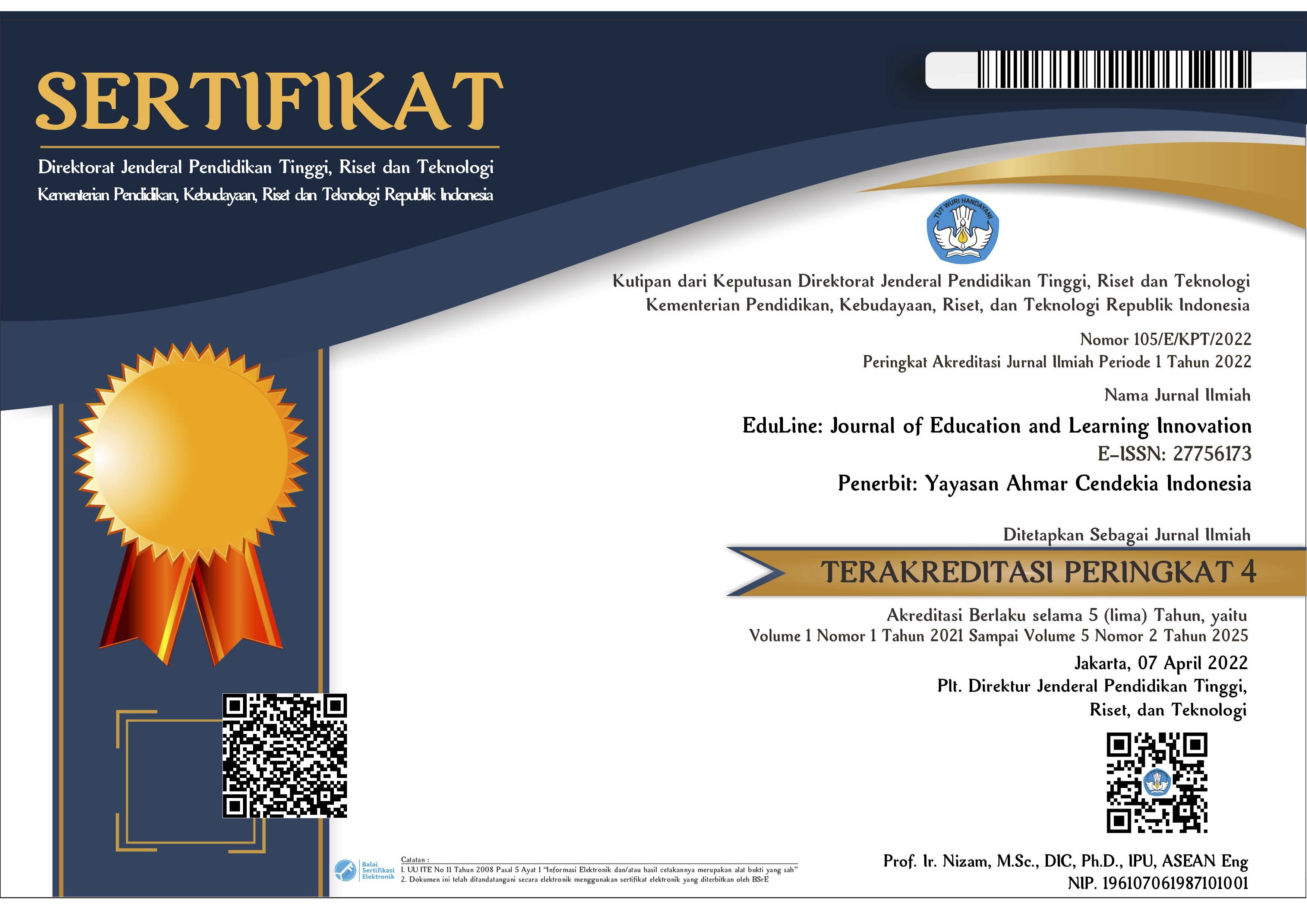
Lecturers’ Attitude towards the Implementation of Blended-Learning Model at the Law Department of Sekolah Tinggi Ilmu Hukum Biak - Papua
DOI:
https://doi.org/10.35877/454RI.eduline1444Keywords:
Lecturers’ Attitude, Blended-Learning Model, Lowly SupportiveAbstract
The objective of this study is to investigate the lecturers’ attitudes towards the Implementation of Blended-Learning Model at the Law Department of Sekolah Tinggi Ilmu Hukum Biak - Papua. In this study, researchers used qualitative methods. The researcher applied the case study design. The subjects of this study were selected purposively and three lecturers were selected who ever taught English at the Law Department of Sekolah Tinggi Ilmu Hukum Biak - Papua. The instrument used in this study was an interview (depth-interview). The data analysis technique used is thematic analysis. The result of this study confirms that there are three categories of how the lecturers' attitudes towards the Implementation of Blended-Learning Model at the Law Department of Sekolah Tinggi Ilmu Hukum Biak - Papua. These categories are Highly Supportive on Blended Learning (HSBL), Moderately Supportive on Blended Learning (MSBL), and Lowly Supportive on Blended Learning (LSBL).
References
Braun, V., & Clarke, V. (2006). Using thematic analysis in psychology. Qualitative Research in Psychology, 3(2), 77-101.
Choy, T. K., & Quek, C. L. (2022). ‘Does Blended Learning Support Self-Regulated Learning?’: A Literature Review. EdMedia+ Innovate Learning, 597-600.
Creswell, J. W. (2012). Educational research: planning, conducting, and evaluating quantitative and qualitative research. Boston: Pearson Education, Inc.
Creswell, J. W. (2014). Research design: Qualitative, quantitative and mixed methods approaches (4th ed.). Thousand Oaks, CA: Sage.
Eddy, L., Nor-Aziah, A., Jasmine, J., & Mohamed-Amin, E. (2014). Blended learning: Examining concepts and practices. Blended & Flipped Learning: Case Studies in Malaysian HEIs. Bangi: Pusat Pengajaran & Teknologi Pembelajaran, Universiti Kebangsaan Malaysia.
George?Walker, L. D., & Keeffe, M. (2010). Self?determined blended learning: a case study of blended learning design. Higher Education Research & Development, 29(1), 1-13.
Heinze, A. (2008). Blended learning: An interpretive action research study: University of Salford (United Kingdom).
Jackson, A. (2011). A blended learning didactic model for ergonomics instruction based on students preferred learning styles. Paper presented at the INTED2011 Proceedings.
Kvale, S. (1996). Interview views: An introduction to qualitative research interviewing. Thousand Oaks, CA: Sage Publications.
Ma'arop, A. H., & Embi, M. A. (2016). Implementation of blended learning in higher learning institutions: A review of the literature. International Education Studies, 9(3), 41-52.
Maatuk, A. M., Elberkawi, E. K., Aljawarneh, S., Rashaideh, H., & Alharbi, H. (2022). The COVID-19 pandemic and E-learning: challenges and opportunities from the perspective of students and instructors. Journal of Computing in Higher Education, 34(1), 21-38.
Mason, J. (1996). Qualitative researching. London: Sage.
Mastan, I. A., Sensuse, D. I., Suryono, R. R., & Kautsarina, K. (2022). Evaluation of distance learning system (e-learning): a systematic literature review. Jurnal Teknoinfo, 16(1), 132-137.
Oliver, M., & Trigwell, K. (2005). Can ‘blended learning’be redeemed? E-learning and Digital Media, 2(1), 17-26.
Olivier, J. (2011). Accommodating and promoting multilingualism through blended learning. North-West University.
Pomykalski, J. J. (2022). Using LinkedIn Learning as a Component of Blended Learning in Two Separate Analytics Courses—Early Results. Paper presented at the Proceedings of the EDSIG Conference ISSN.
Potter, J. (1996). Discourse analysis and constructionist approaches: theoretical background. In J. Richardson, T.E. (Ed.), Handbook of qualitative research methods for psychology and the social sciences (pp. 1-30). Loughborough: Loughborough University.
Rakoczi, G. (2022). Changing from blended learning to fully online learning: Does the change influence the learners’ experiences and perception of a 360 lecture? Paper presented at the EdMedia+ Innovate Learning.
Roberts, M. L., Liu, R. R., & Hazard, K. (2005). Strategy, technology and organisational alignment: Key components of CRM success. Journal of Database Marketing & Customer Strategy Management, 12(4), 315-326.
Thomas, J. C. (2008). Administrative, faculty, and staff perceptions of organizational climate and commitment in Christian higher education. Christian Higher Education, 7(3), 226-252.
Tshabalala, M., Ndeya-Ndereya, C., & Van der Merwe, T. (2013). Academic staff's challenges in adopting blended learning: Reality at a developing university. Paper presented at the International Conference on e-Learning.
Tshabalala, M., Ndeya-Ndereya, C., & van der Merwe, T. (2014). Implementing Blended Learning at a Developing University: Obstacles in the Way. Electronic Journal of E-learning, 12(1), 101-110.
Winter, N., Russell, L., Ugalde, A., White, V., & Livingston, P. (2022). Engagement strategies to improve adherence and retention in web-based mindfulness programs: systematic review. Journal of Medical Internet Research, 24(1), e30026.
Yao, M. (2022). The antecedents to perceived individual learning among Chinese high school students post COVID-19: A Blended learning perspective. Asian Bulletin of Online Education and E-Learning, 2(1), 42-53.
Yulia, H. (2017). Readiness for Blended Learning viewed from the Students Attitude towards Learning Aspects. International Journal of Active Learning, 2(1), 15-26.
Downloads
Published
How to Cite
Issue
Section